




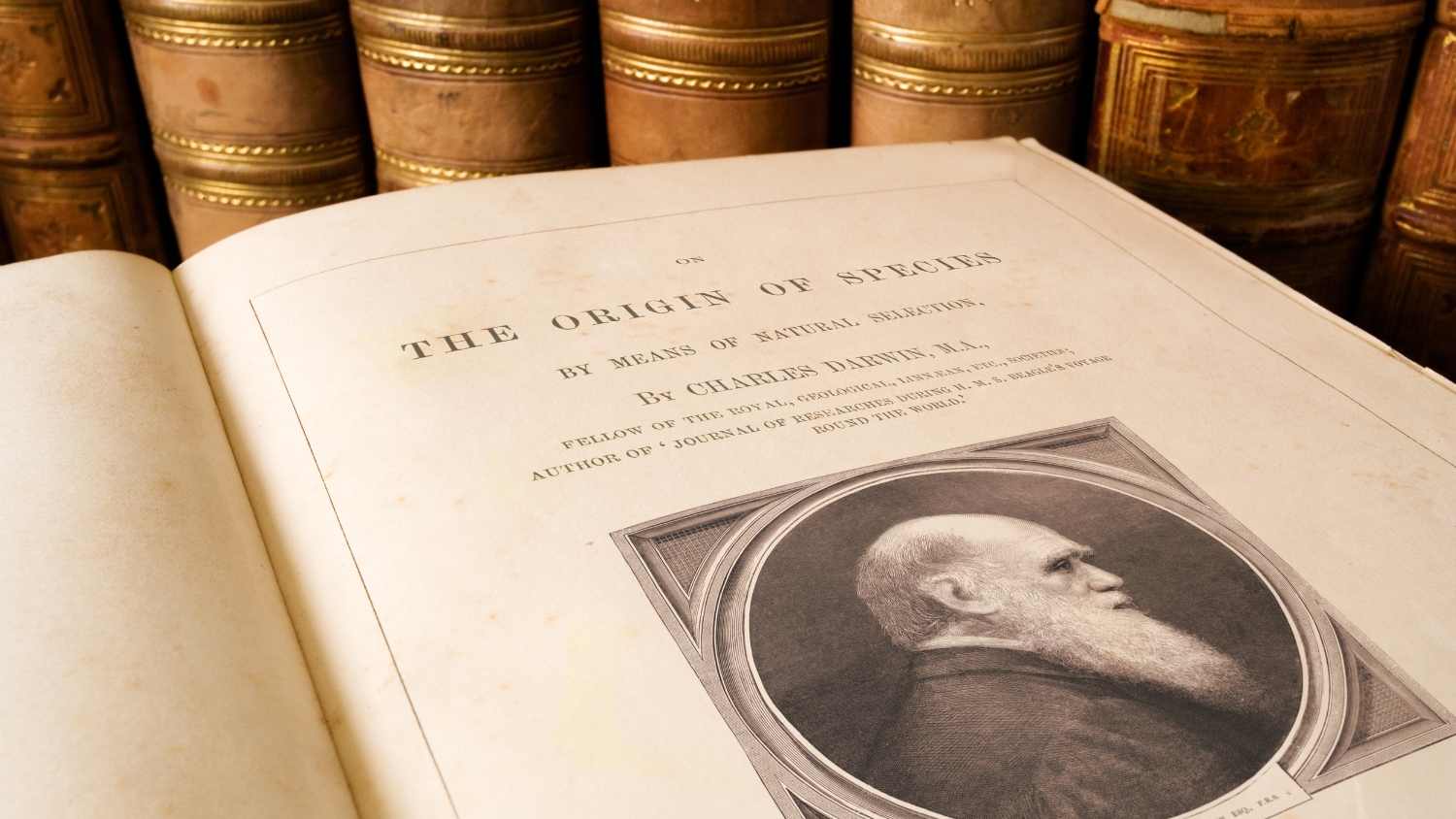
Darwinâs Horrid Doubt
Even âthe fatherâ of evolutionary theory found holes in his belief system.
07/7/26
John Stonestreet and Thaddeus Williams

Charles Darwin, the father of modern evolutionary theory, once wrote in a personal letter to a friend: âThe horrid doubt always arises whether the convictions of manâs mind, which has been developed from the mind of the lower animals, are of any value or at all trustworthy.âÂ
Today on Breakpoint, theologian and professor Thaddeus Williams, talks about Darwinâs Horrid Doubt and why it matters.Â
Do you understand Darwinâs âhorrid doubtâ? If our minds came from a capital âMâ MindâGodâgifted to us as truth-knowing mechanisms, we have a reason to reason. But if our minds came from a non-mind, a literally dumb process of random mutations and natural selection, then our minds are not fundamentally truth-knowing mechanisms, but mere survival mechanisms. We cannot trust our minds on an atheistâs story of our origins any more than we can trust in Darwinâs words, âthe convictions of a monkeyâs mind.â  Â
With progress in the field of philosophy of mind since Darwinâs dayâespecially over the last fifty yearsâwe have found at least nine profound reasons that Darwinâs horrid doubt was justified. How could the impersonal and mindless âIt,â that is the material world, possibly account for nonmaterial realities people experience ten thousand times a day? Â
There is the reality of I-ness, that is first-person consciousness, being more than an impersonal âIt.â This reality is known by philosophers as indexicality. There is also about-ness, the ability to think abstractly: one can think about Mars without the splitting headache of the Red Planet materializing in your brain matter, because thoughts can be non-physical. Then thereâs what-itâs-like-ness, the phenomenological texture of subjective experience or what philosophers call âqualia.â Â
Thereâs also for-ness, or oneâs ability to think toward goals, known as âteleology,â and therefore-ness, which are the laws of logic that arenât physical. There is this-or-that-ness, which is choice-making power that canât be reduced to machine-like determinism or quantum indeterminism. We also experience, awe-ness, creativity and beauty that go beyond the physical. Every day we use what-ness, that is, the meaning in language that transcends its physical medium, known as âsemantics.â And we all experience, ought-ness, the reality that moral values that canât be reduced to chemicals clashing or neurons firing.Â
Do you see the big point? If we originate from mindless matter alone, then weâthe hunks of sophisticated steak that we areâmust make faith leap after faith leap to pretend we have a reason to trust reason and all that goes with it.Â
Thankfully because the capital âMâ Mind, who is God, exists, our minds are at home in reality. In Him, we find a reason to reason. Our freedom, morality, logic, meaning, creativity, individuality, experience, and purpose are no longer explained out of existence but are nourished and expanded. Reason and imagination are not reduced to mere survival mechanisms. They are truth-knowing and beauty-making mechanisms gifted to us by a God of truth and beauty. Â
Human reasoning and creative powers are not the product of dumb forces. They come from God. So, letâs not waste them. Letâs obey Jesusâ greatest commandment to love God not only with our hearts, souls, and strength, but also our minds.Â
That was theologian and professor Thaddeus Williams, author of the book Revering God, and the soon to be released book Reflecting the Son. Learn more about his work by visiting the Shed & Beam YouTube channel. Â
Share


Have a Follow-up Question?
Up
Next


Related Content
 Another Discovery Affirms the Historicity of the Bible April 6, 2022John Stonestreet and Timothy D Padgett Articles, BreakPoint The Bible doesnât claim to be true in some watered-down âspiritualâ sense. It claims to… …
 How Christianity Changed the Way the World Sees Disability, What Many Miss about Happiness, and New Study on Trans Surgery March 7, 2025John Stonestreet and Maria Baer Articles, BP This Week John and Maria discuss DJ Daniel, Disability Awareness Month, and Christian history. …
 A Moment for Renewing Education and the Consequences of Over-Diagnosing Prenatal Conditions February 28, 2025John Stonestreet and Maria Baer Articles, BP This Week Big changes are being proposed to how we do education in America. …
Your gift will have DOUBLE the impact on pastors like Ryan!
"I wanted to.... teach my congregation to live in the world faithfully and not just share a gospel presentation. It's about being able to tell a story about what God's doing in the world."


© Copyright 2020, All Rights Reserved.





Learn
Connect

Programs
Store
Sign up for the Daily Commentary